
We are all descended from an Irish Queen.
I’ve been playing with my Ancestry.com family tree for a couple of years now. Most records for my grandparents, Polish and German immigrants, end in the 1800s. But every so often new small bits are available: a census document, an obituary that’s no longer behind a paywall.
There’s one grandparent who I never explored, though. My grandfather, James.
More than any other leaf on that family tree, I hold deep resentment for him. He’s a man I actively wanted to disown. A man who I felt I had long ago expunged from my body.
When I was just 10 years old, my mother disclosed to me his crimes: he was an abuser. One who never once faced a consequence.
His name and legacy were colored by the trauma of my mom telling me about this abuse. I had no interest in him. He was disowned. So, when constructing my family tree, why would I want to dig into his past?
But curiosity is a funny little badger. It digs. So, last week, I finally clicked his leaf to see what lay behind.
And then, the digital gates crashed open.
Unlike my other ancestors whose records end in the 1800s, James was a genealogical slot machine jackpot. One record linked to another seamlessly. I found a complete book on the family’s immigration from Scotland to Appalachia, detailing their history with excerpts from their letters. Suddenly I was out of the 18th century and rushing backward through time. Scottish immigrants led to Norman knights. Knights led to Frankish nobility. Before I knew it, I was staring at names right out of a history textbook: Charles the Simple. Ermentrude of Orléans. Charlemagne.
And my absolute favorite discovery: Gormlaith ingen Murchada, a 10th-century Irish Queen described by historians as infamously bitchy. (As a feminist who has reclaimed that word as a shield for my own sovereignty, I cackled. Get it, girl.)
For a few hours, I felt incredibly special.
Here was James, the grandfather I actively wanted to disown, whose name was colored by trauma. On the one hand, I felt a sense of “I’m not supposed to want to know this.” On the other, I was descended from emperors and warrior queens!
But then… I did the math.

The Collapse of the Ego
Here is the wild reality of genealogy: if you go back about 1,000 years, the family tree collapses back in on itself. I’ve talked at length about how spirit, nature, and life take on the shape of a spiral. We expand and “progress”, but loop back around to what we’ve seen before.
And it’s clear that genealogy does, too.
1,000 years ago there were less than 50 million people in the world. That means there weren’t enough people alive back then for us all to have separate ancestors. We share them all.
If you have any European ancestry, you are a direct descendant of Charlemagne. Of Ermentrude of Orléans. These people are not just my great-grandparents (x40); they’re likely yours, too. And the great-grandparents of the barista making your coffee, the politician you hate on TV, and the neighbor you’ve never spoken to.
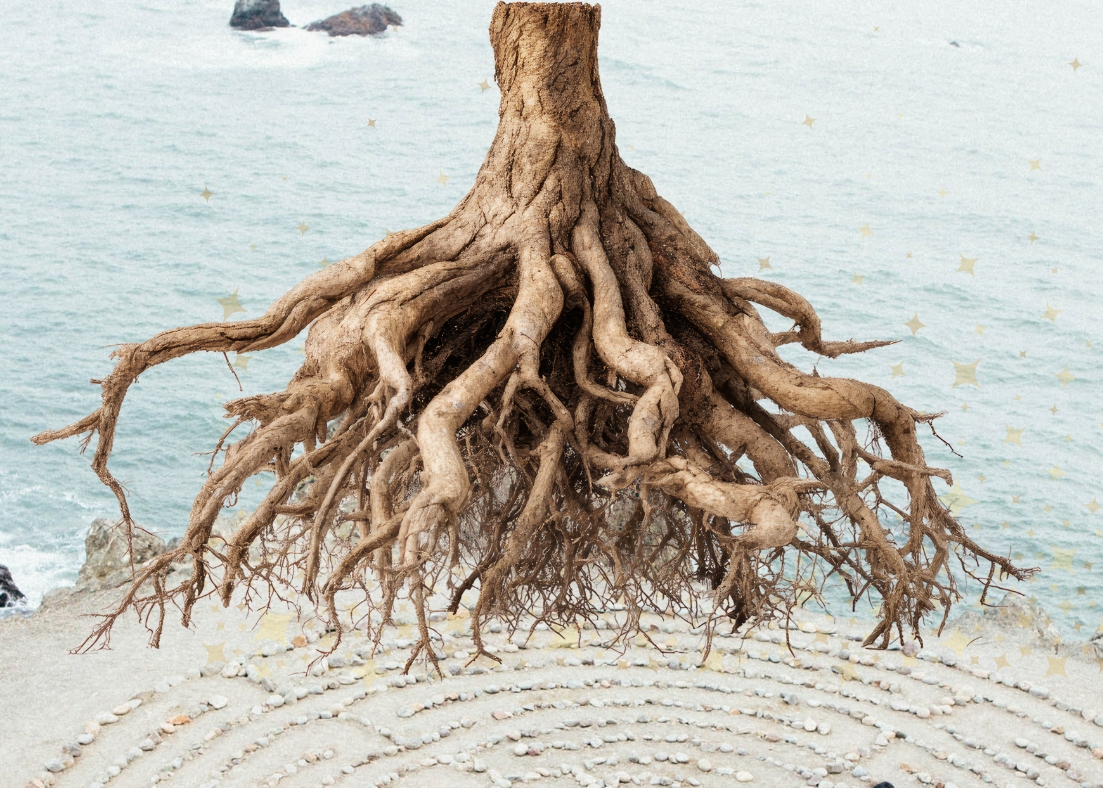
We are not separate trees standing alone in a forest. We are a dense, tangled root system beneath the soil. What looks like a grove of individual trunks is actually one organism, connected underground in ways we can’t see from the surface.
This phenomenon is called pedigree collapse (or sometimes “genealogical collapse”). It’s the idea that the further back you go, the more your ancestors must overlap because there simply weren’t enough humans. It applies to basically any relatively connected population. But there’s also a point even further back where we all have identical ancestors — that estimated date is around 3,000-5,000 years ago for humans, when every person alive was either an ancestor of everyone living today or an ancestor of no one living today.
Seeing this massive web made my resentment toward my grandfather seem… small. His toxicity was just one drop in an ocean of history.
My first reaction to following James’s line to Ermentrude of Orléans’s Wikipedia page was confidence. I felt for a moment that if my ancestors had done impossible things like build nations, make scientific discoveries, or resolve impossible conflicts, then I can be bold and courageous too.
But the moment I understood that all of us are connected to history in the same way, I felt the urge to weep. We are collectively descended from ancestors who beat the odds and made history. That means we live today with the collective potential to again make revolutionary change and discoveries.

The Mother Line as the Nesting Doll of History
Over the last week I’ve been reflecting on this and what it means to me to have these Wikipedia-having historical figures in our family trees. And I realized that they took on a sort of archetypal energy in my mind, a collective ancestor who might well be called on by any and all of us at any time. But the local ancestors felt powerful in a different way. While I could call on the Irish Queen Gormlaith, I felt called upon by my more immediate ancestors. By women.
It’s the women who carry the line through plagues, wars, and migrations.
It was Antonina, my Polish great-great-grandmother — a farmer whose resilience is the bedrock of my maternal line and is the oldest ancestor matrilineally for whom I have record or knowledge. I don’t know what her hands looked like but I imagine them in soil. I don’t know what her dreams were when she came to America with her brother, but I can hope I’m realizing them.
I am a biological nesting doll. I was once an egg inside my mother’s ovaries while she was a fetus inside my grandmother’s womb. That unbroken chain of women is at once a powerful metaphor and a physical reality that connects me to the beginning of human history.
What We Owe Each Other
This discovery didn’t make me feel special for long. Once I understood pedigree collapse, my initial glee was humbled deeply. The fact that I felt any initial excitement at all – that I somehow had more potential because I found these powerful figures in my family line – represents the profound indoctination of hierarchical and patriarchal thinking that I still have left to unlearn.
Once I understood how this all works, though, my Spirit rested into something much more powerful than that initial excitement. It made me feel profoundly connected: a feeling that has lasted, without interruption, for days now.
As I watch the protests and marches against ICE, witness more and more families torn apart my inhumane and violent deportations, that sense of connection isn’t just moving me romantically. It’s moving me to act.
We are all walking around with the blood of empire-builders, revolutionaries, artists, scientists, and resilient farmers pumping through our veins.
We are all capable of greatness because we are all descended from it.
And this is where the spiritual lesson is at once political and economic:
If we are all intricately, undeniably connected by blood and history, then the modern myths of hyper-individualism and capitalism are lies. The idea of the “self-made man” is a joke when you see the legion of ancestors standing behind every single one of us.
My husband is African American, carrying a lineage with its own profound sagas of survival and kingship. Our children are the synthesis of these massive, global histories coming together. That is the future.
We have spent too much time acting like islands, competing for scraps. But the records don’t lie: we are a collective. We are a family that has forgotten its own name. And we need to clean house.
Billionaires hoarding resources that belong to the collective lineage. Fascists drawing lines between “us” and “them” when the reality refuses such borders. ICE tearing apart families as if some branches of the human tree matter less than others. White supremacy insisting on a hierarchy that has long been revealed to be fiction.
These are spiritual delusions as much as they are political problems.
I looked into the eyes of an ancestor I hated and found out how much I love the human family I belong to. His abuse doesn’t disappear. The harm he caused my mother doesn’t heal because I now know we share blood with Charlemagne. But it contextualizes. It reminds me that I am not only his descendant. I am the inheritor of thousands of lines of survival, resistance, rupture, repair, and stubborn hope.
And so are you.
So are the people being loaded onto deportation flights right now. So are your neighbors. So is the person you find most difficult to love.
We’ve been taught to see ourselves as separate trees. To measure our worth by how tall we stand alone, how far our individual branches reach. But the truth is underground. The truth is in the roots. And the roots say: you are not alone. You never were.
Who’s the ancestor you’ve disowned? What might be waiting behind that leaf? And what might it change about how you see the strangers you pass on the street — knowing that a thousand years ago, you shared a grandmother?

Practices for Meeting Your Ancestors (The Known and The Mighty)
If this has stirred something in you, here’s where to start.
1. Distinguish between your Known Dead and your Mighty Dead.
Your Known Dead are the close ones — the grandparents, great-grandparents, the names you heard at kitchen tables. Their choices directly shaped your immediate reality. They’re close to the veil and usually most invested in your daily life.
Your Mighty Dead are the archetypal figures. This is the Charlemagnes, the Gormliaths, the names on Wikipedia. When you work with them, you’re not just connecting to a person; you’re connecting to the energy they carried: sovereignty, empire-building, artistic creation, survival against impossible odds. Because they’re shared ancestors, they’re available to anyone who calls on them.
Both matter. But they serve different purposes.
2. Start with who’s tapping your shoulder.
You don’t have to chase down every leaf on the tree. Notice who keeps showing up. Whose name makes you pause? Whose story creates a strange resonance in your chest?
For me, it was Ermentrude of Orléans — a Carolingian queen and embroiderer. I felt a “zap” when I saw her tomb carving. The other was Gormlaith. When I read about her, I knew her real story wasn’t being told. I felt myself rooting for her.
3. Create a point of contact.
This doesn’t have to be a full altar (though it can be). It can be as simple as:
- A photograph or printed image placed somewhere intentional
- An object that represents their world (soil for a farmer, a needle for a seamstress, a stone for someone from the mountains)
- A candle lit with their name spoken aloud
The Known Dead get your daily coffee and candles. Be consistent with intimate tending. The Mighty Dead you call more so call upon for big life-path questions, when you need to borrow the energy of someone who moved through history and left a mark.
4. Journal prompt: Ancestors for the Altar
Take fifteen minutes and write responses to these:
- Who is the oldest ancestor I know by name? What do I know about their life?
- Is there an ancestor I’ve avoided or actively disowned? What am I afraid I’ll find if I look?
- Is there a historical figure I’ve always been fascinated by? Did something in their story call to me? (Consider: they might be your ancestor too! The web is so much wider than you think.)
- What quality do I most need to embody right now? Which ancestor — known or mighty — carried that quality?

This Matters for the Revolution
I don’t encourage you to pursue ancestor work and The Mighty Dead to feel special about your bloodline. The opposite, actually. I’m encouraging you to pursue it because we have a lot of history-making work to do for the good of the all.
We are living through a moment that demands we remember who we are and what humans are capable of. The economy needs to be remade. Land needs to be returned to its indigenous stewards. White supremacy needs to be dismantled. The rights of marginalized people and children need to be restored and protected with everything we have.
These projects are generational. They’re the kind of things that seem impossible until you remember our ancestors did impossible things too.
They survived plagues, wars, famines, and migrations. They built movements, hid refugees, led revolutions, fed children through collapse. They made choices that beat the odds. That’s why you’re here.
Pedigree collapse means this world is our inheritance. Collectively, we are descended from every human who survived to pass on life. That means we carry the collective capacity to do what they did: face the impossible and build something new anyway.
When I work with clients, this is often where we start. Not with tactics. With remembering. Reconnecting to the resilience that’s already in your bones. Finding the confidence that comes from knowing you are not a single tree trying to stand alone in a storm — you are part of a root system that has weathered storms before.
From that place, you can build. You can act. You can stop performing productivity for a dying system and start channeling your energy toward what actually matters.
If You Want Support for Your Part of the Work
Pocket Witch is my ongoing mentorship for people navigating their own becoming. Career transitions, creative projects, business pivots, identity reclamation. I support this practically while helping you stay connected to something bigger than the grind.
We work with spirit, Tarot, ritual, and strategic tactics to help you:
- Reconnect with who you are outside your job title
- Build practices that sustain you through the long work ahead
- Trust your intuition as strategic intelligence
- Design rituals for the specific thresholds you’re crossing
You’re walking a spiral. Pocket Witch is support for the spiral.

Leave a Reply