
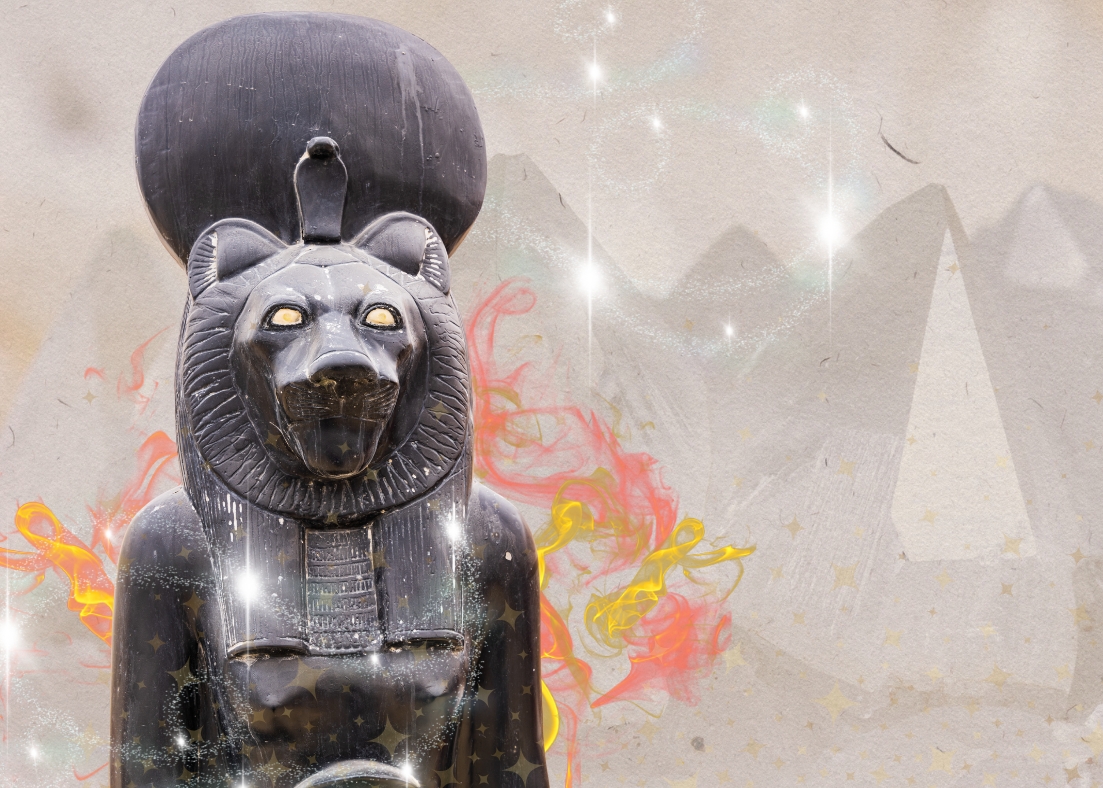
What would it mean to embody the Lady of Slaughter in your career?
I resisted Sekhmet for years.
As a Pacific Northwest forest girly who plays druids and clerics in video games, who writes poetry and loves word witchery, who imagined herself more hobbit than warrior…. a bloodthirsty lioness goddess just didn’t fit my “aesthetic.” Do you know what I mean?
Kind of like if I worked with a Goddess or incorporated that energy into my life, it wouldn’t fit the wider puzzle or image I was trying to create.
But this is Sekhmet, darling. She showed up anyway.
It was like 3am one night and I couldn’t sleep. I was super anxious about work – I had an awful day prior and was dreading going in the next. On a macro-level, I was still trying to transition out of teaching (notoriously hard) and it was feeling impossible.
So I was up and anxious.
As a witchy woman does, I went to my altar, lit some candles, and closed my eyes to breathe. Before I tell you this, let me be clear that I am not a strong psychic girlie. I have my moments, of course, but this was certified wild.
When I closed my eyes, I immediately saw the face of a lioness. Piercing gaze. Right here, inches from my face. Around her was bright golden light, almost rainbow, and it felt warm and hot on my skin.
I opened my eyes, obviously freaked out. I do not have That’s So Raven-style visions. I was still my room, it was still nighttime, and I heard wind in the trees outside.
I closed my eyes again. She was still there.
I stayed. Half-convinced I was lucid dreaming, I just stayed. Waiting.
I didn’t know what to do with her or the vision. I didn’t know what it meant (yet). I just let the moment be what it was: ridiculously spiritual.

Sekhmet Has a Reputation for This
The most amazing part of my experience is that it is not unique!! Sekhmet has a reputation for inspiring intense emotional, visionary, and somatic experiences in people. When I was living in London I often visited the British Museum just to see Sekhmet. There is housed the largest collection of granite statues of her likeness. Many were commissioned by King Amenhotep III – he had over 700 made! – as he believed it would help to pacify her. (Here are a few on Google Arts & Culture, if you haven’t seen them.)
Originally ritual objects, their sheer scale and the materials they’re carved from alone have a potency. Combined with the act of enshrining her energy, ensouling it, in these carvings… you get a sense of presence.
Visitors to this collection and visitors to Egypt – ESPECIALLY people who are practitioners of Goddess spirituality – often describe a feeling that the statues are living. People feel heat, pressure, energetic sensations, or experience spontaneous visions, intuitive messages, or emotional release.
Not unlike my weird vision, years before I ever stepped foot in London.
If you want to learn more about this, the article “Seeking Sekhmet” by Olivia Ciaccia offers a great starting point.

When She Came Back
The long and short of it is that aside from the occasional visit to the British Museum and libation of beer at my altar, I didn’t really develop a relationship with Sekhmet. I wanted to, but I felt like Bast was more obvious – she was calmer, cozier.
But then, last year, Sekhmet returned to my life in a big way. I’d taken on a leadership role at a nonprofit, and I was struggling. The nonprofit was in crisis and I was tapped by a combination of skills and circumstance to get it through that crisis. And the burden was heavy, from multiple angles. Financials, operations, internal politicking, legal filings.
I’d been asking Isis for guidance. She’s my usual go-to. But I wasn’t feeling her strength there. She was offering strength and inspiration for The Work Witch, but not for the nonprofit. And my other “spirit allies” didn’t quite fit what mentorship I needed.
Until I came back around to Sekhmet. I reflected on that same golden-light sensation I remembered from years before, and how none of it felt bloodthirsty, violent, or dangerous. It was closer to the experience of not wanting to leave a warm fire, or a warm bed.
So I reread her myths. Her epithets. Her history. Academic interpretations and personal gnosis from other practitioners. And I started asking questions I hadn’t asked before.
The Wikipedia version of Sekhmet goes like this: she was sent by Ra to cleanse the world of evil, but she got addicted to the bloodlust and couldn’t stop killing. Ra had to trick her into drinking red-dyed alcohol, thinking it was blood, to calm her down. Then she transformed into Hathor, the gentle goddess of love. Pacified, the problem was solved.
But… surely that can’t be right.
Is this actually a story about a bloodthirsty goddess who needed to be controlled? Or is it a patriarchal retelling of what happens when a woman’s righteous fury becomes inconvenient?
Think about the myth from her point of view. She went down to Earth on Ra’s orders, doing his dirty work because he was dissatisfied with his creation. And as she was following through on her f*cking job, he suddenly had a change of heart.
Then she was intoxicated without her consent. She was “transformed” into something softer, more palatable, more controllable. The rage that served a purpose (cleansing evil) became the problem the moment it threatened Ra’s status quo.
And I ask you, dear traveler of this earthly realm, doesn’t that sound familiar?

The Warrior You Already Are
Here’s what I realized when Sekhmet came back into my life: I am a warrior. I just didn’t want to think of myself that way.
When I think about the times I’ve been most impactful at work, it’s when I’ve fought for people. I don’t take shit from executives with sticks up their asses. I’ve filed more grievance reports than I probably should have before 30. I’ve won legal cases. I’ve fought to protect colleagues and call out things that were wrong.
Multiple people in my life have described me as a warrior. I used to reframe that as “caring” or “empathetic” because warrior felt too aggressive for my self-image. (My mom once told me that women are soft and pretty, and I think I internalized that to a fault.)
But the energy I bring when I’m protecting someone? The energy I bring to the function? It’s when I’m standing on business for what I believe is just, fair, or right. And frankly, that’s not soft. That’s Sekhmet.
She wasn’t asking me to abandon my forest girlie poetry-writing self. She was asking me to also wear the mantle of warrior woman with pride. To stop pretending that part of me didn’t exist because it didn’t match my aesthetic. To instead look at what matches who I am and the sacred work I do.

What It Means to Embody Sekhmet at Work
Embodying Sekhmet is about fierce, boundaried protection — of yourself, of others, of what matters.
Sekhmet energy knows when diplomacy has failed. She’s what you invoke when you’ve been reasonable, when you’ve followed the proper channels, when you’ve explained yourself clearly — and it hasn’t worked. When the system isn’t listening.
Sekhmet energy doesn’t accommodate broken systems. She doesn’t “lean in” to structures designed to exclude her. (Sorry, Sheryl Sandberg.) She asks: why am I contorting myself to fit a space that was never built to hold me?
Sekhmet energy protects the vulnerable. In her mythology, she was sent to defend against evil. Her violence was in service of something. That’s key. Sekhmet’s is righteous, protective, and ultimately focused on healing & repair.
Sekhmet energy gets labeled “too much.” Women who embody this archetype get called emotional, aggressive, difficult. Their boundaries get reframed as hostility. Their directness becomes a “communication problem.” If you’ve ever been told you’re “too intense” when you were actually just right, you know this energy.
Three Practices for Working with Sekhmet Energy

1. The Transmutation Journal
Create a space to document the situations that light your fire. Think about meetings where you were dismissed, the boundaries that were crossed, the moments you swallowed your response to keep the peace. Don’t stop at recording the injustice. Rewrite the story. What would equity have looked like? What response would have honored your worth? What system would prevent this entirely?
Why bother doing this, you ask? Because Sekhmet is equal parts warrior and healer. When you rewrite the past for yourself, you’re influencing your future. You get to reject “that’s just how things are” and demand better. You’re creating a blueprint for what to require and how to recognize it.

2. Words of Power in the Moment
One of the most Sekhmet things you can do requires no altar, no candles, no ritual prep. Just your voice. Use it to protect others in real time. When you witness someone being interrupted, dismissed, or criticized for behavior that would be praised in others, speak up. Not later. Not in private. In the moment.
“I’d like to hear Jordan finish their thought.”
“That was actually Priya’s idea from last week.”
“That’s an inaccurate characterization.”
These are incantations against erasure. They convert individual vulnerability into collective protection. Have the courage to be disliked, stir the pot, and expect better.

3. Return to the Body
A big thing about warriors and healers is that they’re deeply concerned with the affairs and wellbeing of the body. If you want to bring Sekhmet’s blessings into your life or embody her energy, you need to get moving.
Warrior Goddesses love sweat. Exercise, sex, dancing, yoga, a walk in the sunshine — pick your movement!
I find dance particularly powerful for tapping into Sekhmet as a unified energy with Hathor. It’s rich, freeing, playful, and empowering all at once. (Isis once told me that whenever I’m blocked, I should move and dance to unblock myself. The body knows things the mind is still catching up to.)
Whatever practice you cultivate, let Sekhmet’s image be in your mind during the activity. You can also offer it to her. If you’ve been struggling to make it to the gym and want real commitment, make your visits an offering to the Goddess. If you’ve gone through trauma and need physical therapy, ask for her support as you recover.
However you engage with your body through movement, Sekhmet will bring that strength back into your heart. My personal interpretation of her is that she rules the heart muscle. When our heart is strong, when we can feel it beating in our chest, we’re often more confident, more prepared to take a risk. That courageousness is her domain.

The Rage That Serves
I used to think spiritual practice meant being soft. Becoming gentle, like a monk. Accommodating, like a wise hermit. And sometimes it does mean that. But the range of Goddesses — from Hathor to Isis, Brighid to Hecate — also express the range of spiritual power.
Sekhmet taught me that fierceness is also sacred and my anger is not sinful. That protecting yourself and others is holy work. That there are moments when the most spiritual thing you can do is refuse to back down or give up.
The myth says Ra had to trick Sekhmet into calming down because her power was too much. I love the guy, but this myth needs some critical examination. Who is your Ra? An employer, a friend, a mother, a spouse? What stick are they measuring you with, anyway?
What’s your experience with Sekhmet—or with being labeled “too much” when you were actually just right? I’d love to hear in the comments.
Go Deeper
If Sekhmet is calling you—or if you’re curious which goddess archetype might support your current career transition—I wrote Goddesses for Work, a 40-page guide to getting started with goddess spirituality for ambitious professionals.

And if you want support navigating the warrior path with someone who’s filed the grievance reports & fought back against maternity discrimination and lived to tell the tale, Pocket Witch is ongoing coaching for professionals in transition.
Related:
Leave a Reply