
Ancient wisdom for modern entrepreneurs who refuse to shrink their dreams to fit into broken systems
Hello there, fellow hunters. Today we’re going to unpack the particular agony and stagnation that can come from having too many (good) ideas.
If you’re anything like me, your notes app is bursting with brilliant concepts, your Pinterest is overflowing with private vision boards, and if you happen to wake up in the night you can NEVER fall back asleep because your dream-brain has taken over with creative inspiration.
For most of us spiritual folk looking to live the soft life, it can be hard to admit out loud that that as much as we love our ideas and are in search of soul fulfillment, we also want some level of financial freedom as a result of pursuing them. But avoiding this truth causes us to avoid the necessary step of applying some strategic rigor and analysis to our magnificent daydreams.
This is especially true for artists, writers, social entrepreneurs, nonprofit founders, and spiritual business owners.
When I first started The Work Witch, I had a few clients **in a row** (like, 3 in one day) who came with the same dilemma: too many ideas. One, a freshly graduated and inspired woman, had seven that she had thought through and showed me the Google doc. “I know I need to commit to something,” she said. “But I feel like that’s being asked which pets to save from a burning building. I love them all.”
Here’s a version of what I walked her through.
If you’ve ever felt frozen by your own potential to follow many different paths through the woodland of life, I hope this post is your strategic wilderness guide.
The Problem with “Follow Your Passion” Advice
Here’s what most business & self-help advice gets wrong: it treats idea selection like a meditation retreat instead of a hunting expedition.
“Follow your passion!”
“What lights you up?”
“Trust your intuition!”
Cool. Nice on the surface. Largely unhelpful in practice.
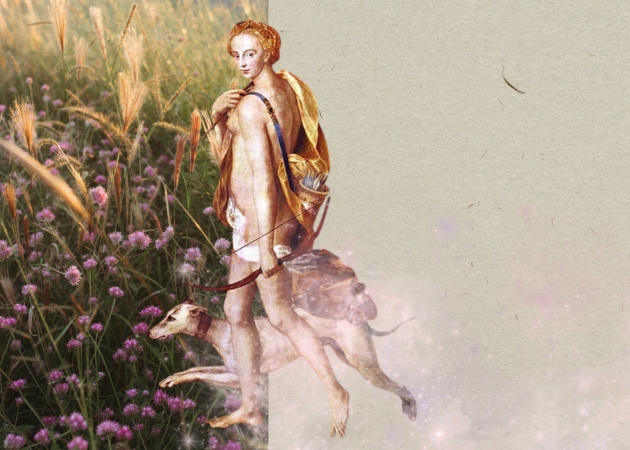
The Goddess Diana teaches us something different about strategic decision-making. When you’re in the wilderness with limited arrows, you don’t get to hunt everything that moves. You study the landscape, understand the ecosystem, and choose your target with both heart AND strategy.
Diana wasn’t just following her bliss in those ancient forests (though there’s a cottagecore vibe in there too)—she was reading market conditions, understanding resource scarcity, and making strategic decisions about where to focus her energy for maximum impact.
Your business ideas and creative projects, I think, deserve the same level of strategic AND spiritual consideration before you decide which to pursue.
Why Your Brain Becomes a Business Idea Hoarder
Before we dive into Diana’s method, let’s understand why this happens in the first place.
You’re experiencing the overwhelm of a creative Spring: that period when you emerge from a creative Winter defined by consumption and rest (reading books, taking courses, scrolling LinkedIn for inspiration). When Spring hits, suddenly every possibility feels urgent and exciting.
Your ambitious brain sees opportunities everywhere:
- I could start that consulting practice
- I could launch that course
- I could write that book
- I could create that app
- I could start that nonprofit
This flood of ideas isn’t a character flaw—it’s actually market intelligence and self actualization having a lovely dance. Your pattern-recognition system is working overtime, spotting gaps and opportunities, while your soul is feeding back endorphins on the ideas that would bring you joy.
The problem is that most people get stuck in endless exploration mode, afraid to commit to one path because it means saying no to all the others. (And ideas and daydreaming are also super fun.)

Diana’s Three-Arrow Assessment for Business Ideas
The goddess Diana teaches us that effective hunting requires three essential elements, and the same applies to choosing your next business venture:
🏹 The Wild Arrow: What Would You Hunt Without Permission?
The Question: Strip away all the “shoulds”—investor expectations, family pressure, industry trends. What idea keeps calling to you when everything else goes quiet?
Diana roamed the wilderness following her own instincts, not the court’s expectations. Your most powerful, worldmaking ideas often live in that same untamed space.
Ask yourself:
- Which idea makes you feel slightly rebellious or “too wild” for your current professional image?
- What would you build if you knew you couldn’t fail?
- Which concept energizes you even when you’re exhausted?
- What solution are you uniquely positioned to create based on your lived experience?
The Wild Arrow isn’t a time to think about practicalities—it’s about identifying the idea that has genuine magnetic pull for you, the one that refuses to be domesticated by conventional business wisdom.
🐕 The Pack Arrow: Who Are Your Fellow Hunters?
The Question: Who’s your community on this path?
Diana never hunted alone—she traveled with loyal companions who shared her vision and complemented her skills.
The most successful and post-capitalist businesses emerge from community, not isolation or extraction. Your idea needs fellow hunters who will:
- Collaborate and co-create with you
- Provide accountability and support
- Become your first customers or advocates
- Challenge and refine your thinking
Evaluate each idea:
- Who would you want as partners, collaborators, or advisors?
- Which communities are already gathering around this problem?
- Where do you feel excited to show up and contribute?
- Who else is working on adjacent solutions you could learn from?
If you can’t identify your pack for a business idea, it might be too early—or too isolated—to pursue.
🌱 The Service Arrow: How Does This Regenerate the Ecosystem?
The Question: How does this business serve something larger than your bank account?
Diana protected the wilderness from exploitation—your business should regenerate rather than extract.
This isn’t about being charitable (though that’s lovely). It’s about strategic sustainability. Businesses that solve real problems for real people create their own momentum and word-of-mouth marketing.
Consider:
- What frustration or gap inspired this idea?
- How would the world be different if this business succeeded?
- Who specifically benefits from what you’re creating?
- How does this contribute to the economic ecosystem you want to live in?
Your Service Arrow helps you identify businesses with long-term viability instead of short-term money grabs.

The Strategic Release: From Analysis to Action
Once you’ve assessed your ideas through Diana’s three arrows, it’s time for the hardest part: choosing one and releasing it into the world.
Here’s the truth that nobody wants to hear:.. you don’t need the perfect idea, you need the courage to test a good one.
Diana didn’t get unlimited arrows. Neither do you. But here’s what she understood that she can teach you too: your first shot doesn’t have to be your last shot. Build courage to aim.
The Minimum Viable Hunt
Instead of building a full business plan, start with what I call a Minimum Viable Hunt:
- Choose the idea that scored strongest across all three arrows
- Define the smallest version you could test in 30-60 days
- Launch something simple (landing page, pilot program, beta service, event, meetup)
- Learn from real market feedback, not theoretical planning
- Iterate based on what you discover
Permission to Pivot
Here’s the permission slip you’ve been waiting for: your first business idea doesn’t have to be your forever business idea.
Every successful small business or spiritual entrepreneur I know has a graveyard of previous ventures that didn’t work out as planned. They succeeded not because they found the perfect idea, but because they developed the skills to execute, learn, and adapt.
Diana teaches us that the wilderness is vast and full of possibilities. You explore it by moving through it, not by standing at the edge analyzing all possible paths.
Why You’re Actually Afraid to Choose
The real reason you’re stuck isn’t lack of clarity—it’s fear of missing out on the “better” option.
But here’s what I’ve learned from working with ambitious women ready to transform their ideas into reality: the world needs what you’re thinking about creating.
People are actively searching for solutions you could provide. They’re seeking services that align with their values. They’re hoping someone like you will build the thing they need.
Your job isn’t to find the perfect idea—it’s to develop the strategic courage to test your good ideas and the implementation skills to make them work.
Your Next Steps: From Idea Overwhelm to Strategic Action
This week:
- Apply Diana’s Three-Arrow Assessment to your top 3-5 business ideas
- Choose the one that scores highest across all three arrows
- Tell three trusted people about your choice (accountability creates momentum)
This month:
- Create your Minimum Viable Hunt version
- Get it in front of 10 potential customers for feedback
- Document what you learn about market demand
Next quarter:
- Based on results, either double down or apply your learnings to the next arrow in your quiver
The Bottom Line: Your Ideas Need You to Act
Your most sacred business ideas shouldn’t be domesticated by conventional wisdom or controlled by anyone else’s timeline. They need wilderness space to grow—but they also need you to eventually release the arrow.
The future is up for grabs, and the economic ecosystem we’re building needs leaders who integrate both strategic thinking and spiritual wisdom.
So here’s my question for you: Which arrow are you holding back right now? Which business idea keeps returning, asking to be released into the world?
Your quiver is full of possibilities. Your strategic mind is sharp enough for any target. All that remains is the courage to honor your wild ideas with focused action.

Ready to transform your business idea overwhelm into strategic clarity? I help ambitious changemakers navigate major career transitions and business decisions through tarot-guided strategy sessions. Book a reading here to explore which of your ideas is ready for the wild.
Leave a Reply